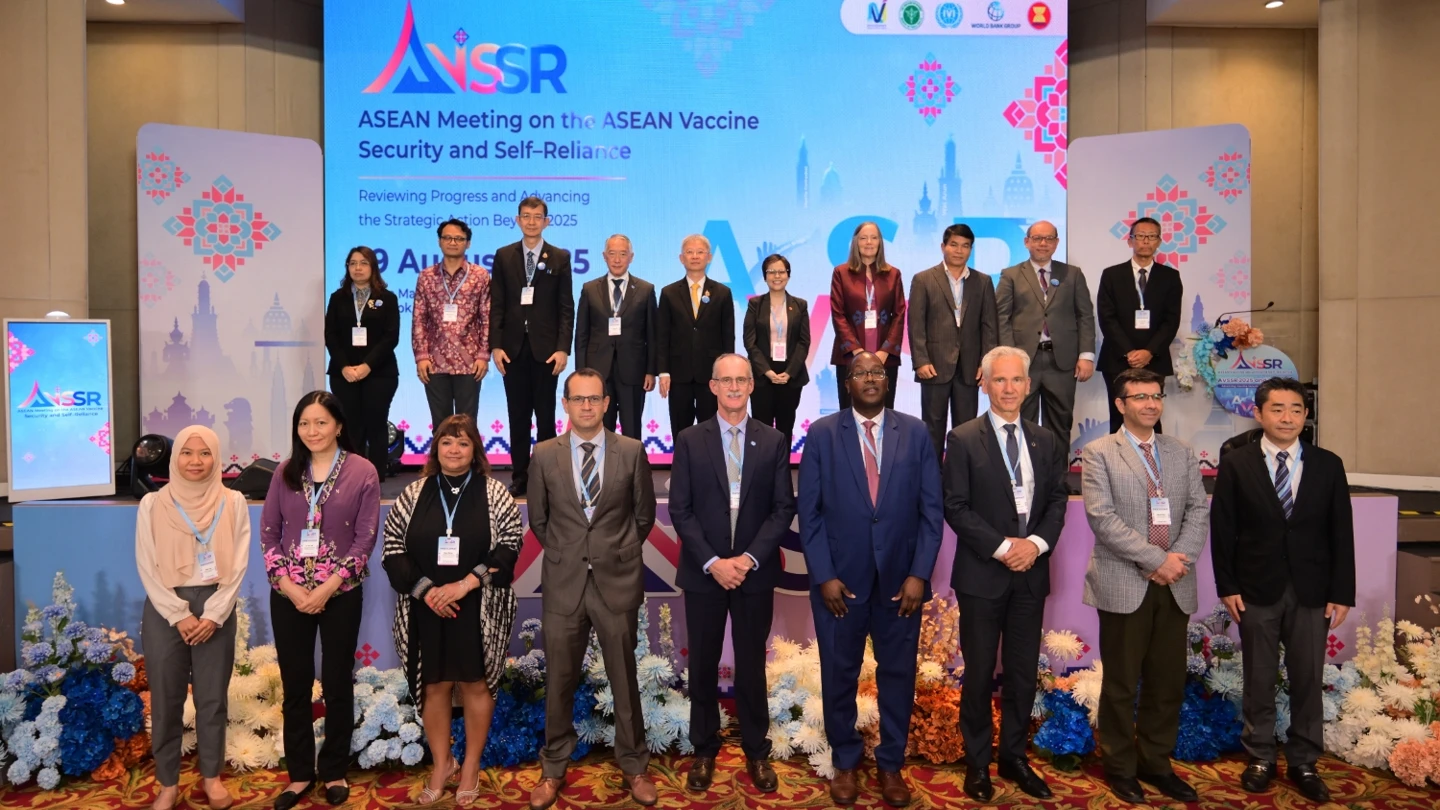
The COVID-19 pandemic exposed the risks of relying too heavily on external vaccine supply. Across the Association of Southeast Asian Nations (ASEAN), countries faced delays, shortages, and limited ability to rapidly access vaccines when global demand surged. Since then, ASEAN Member States and partners have taken important steps to strengthen regional vaccine security and pandemic preparedness.
The upcoming ASEAN Vaccine Security and Self-Reliance (AVSSR) meeting on 30 June 2026 provides a timely platform to build on this momentum. Launched before the pandemic, AVSSR aims to strengthen the region’s ability to secure timely, affordable, and quality-assured vaccines, including during future health emergencies. As ASEAN Member States consider the next phase of AVSSR, the central question is how to ensure that regional capacity is sustainable, trusted, and available when countries need it most.
Recent analysis by the RVMC Secretariat and the Clinton Health Access Initiative (CHAI) highlights three priorities for ASEAN Member States to consider in the next phase of AVSSR.
1. Create a stronger regional demand signal for ASEAN-made vaccines
For regionalized vaccine manufacturing to contribute meaningfully to vaccine security, manufacturers need predictable demand. Without a credible market, manufacturers may focus primarily on domestic or global opportunities. This may be commercially rational, but it risks leaving ASEAN without the “ever-warm” capacity needed to respond to future outbreaks and pandemics.
ASEAN Member States could consider how national procurement decisions can better support regional vaccine security. This could include, where appropriate, considering whether a vaccine is manufactured in ASEAN or whether the supplier has the capability and willingness to serve the region during a health emergency, alongside existing criteria such as quality, safety, efficacy, affordability, supply reliability, and programmatic suitability.
Countries could also use AVSSR to explore practical ways to coordinate demand across the region. This does not necessarily require a fully pooled procurement mechanism from the outset. Initial steps could include better sharing of demand forecasts, identifying priority antigens of regional interest, and piloting coordinated procurement.
Over time, a stronger regional demand signal could help manufacturers plan investments with greater confidence, while giving countries improved access to trusted regional supply.
2. Make regulatory pathways work better for regional supply
Manufacturing capacity alone will not deliver vaccine security if products cannot move efficiently across borders. Fragmented regulatory requirements across ASEAN can increase the time, cost, and complexity of market access, making it harder for regional manufacturers to supply multiple countries.
ASEAN Member States should consider how AVSSR can support more practical regulatory cooperation for vaccines. Full regulatory harmonization is a long-term goal, but countries can take more immediate steps. These include expanding the use of regulatory reliance, strengthening joint assessment procedures, and identifying trusted reference authorities within the region.
For vaccine-producing countries, this means ensuring that national regulatory systems can support products intended for regional use, not only domestic use. For vaccine-purchasing countries, it means considering where reliance on trusted regulatory decisions could accelerate access to quality-assured vaccines, particularly in emergencies.
AVSSR could provide a platform to connect existing ASEAN regulatory initiatives more directly to vaccine security objectives. The aim should be to reduce unnecessary duplication, support timely market entry, and ensure that products manufactured in the region can be made available across the region when needed.
3. Strengthen complementary manufacturing capacity across the region
ASEAN already has important vaccine manufacturing assets. However, capacity remains concentrated in a limited number of manufacturers and countries. This creates risks if a major facility is disrupted, demand surges, or the region needs flexible capacity for priority outbreak pathogens.
ASEAN Member States could use AVSSR to consider the mix of manufacturing capabilities the region needs and where complementary capacities should be strengthened. This does not mean every country needs to manufacture every vaccine. Rather, countries could work together to identify the capabilities that are most important for regional preparedness, including drug substance production, fill-finish capacity, platform technologies, quality systems, workforce development, and readiness for technology transfer.
To support this, AVSSR could help define priority products and capabilities, identify manufacturers with the strongest potential to serve regional needs, and align investments with both public health priorities and commercial sustainability. The goal should be a more diversified and connected regional ecosystem, rather than fragmented national efforts.
Our approach
We are supporting the next phase of AVSSR by bringing evidence, regional analysis and partner perspectives to discussions on how ASEAN can strengthen vaccine security through sustainable regionalized manufacturing.
This includes sharing market-shaping recommendations developed with CHAI on how ASEAN can build a more sustainable regional manufacturing footprint, and working with partners, including the World Bank Group, to ensure that regional approaches are informed by the needs of both vaccine-producing and vaccine-purchasing countries.
We are also supporting ongoing discussions with the National University of Singapore and Thai National Vaccine Institute on the potential role of pooled or coordinated procurement in strengthening regional demand. This work draws on lessons from other regions, including PAHO’s Revolving Fund, while recognizing ASEAN’s specific institutional context and priorities.
In parallel, we are engaging partners to better connect procurement, regulatory cooperation, and regional manufacturing objectives, including through alignment with the ASEAN Pharmaceutical Regulatory Framework and ongoing work of the ASEAN Pharmaceutical Product Working Group (PPWG) and Joint Assessment Coordinating Group (JACG)
Across this work, the aim is to support practical pathways that help translate AVSSR’s ambition into a more coordinated, sustainable, and resilient vaccine ecosystem for the region.
Conclusion
The next phase of AVSSR is an opportunity for ASEAN Member States to move from ambition to implementation. A sustainable regional vaccine ecosystem will depend not only on investment in manufacturing facilities, but also on the policy choices that make that capacity viable.
Taken together, the recommendations above can help ASEAN build a vaccine ecosystem that is commercially sustainable in peacetime and ready to respond in a crisis. For Member States, the key question is not only whether ASEAN should strengthen regional vaccine manufacturing, but how each country can contribute to a shared system that improves supply security, supports timely access, and strengthens preparedness for future health emergencies.